
What returns policies are quietly costing retailers

Article highlights
- Loop's report The Returns Revenue Gap, a survey of 1,000 Australian shoppers and 200 retail decision-makers, found 55% have changed their buying behaviour because of a fashion retailer's returns policy (reported by Inside Retail).
- 85% check a returns policy at least sometimes before buying, and 91% say return charges affect how they shop.
- Only 10% of retailers named customer churn as the biggest financial cost of returns, focusing instead on lost revenue and logistics.
- The take: returns policy is now a conversion lever, not a back-office cost, and the retailers who win are the ones measuring the customers they lose.
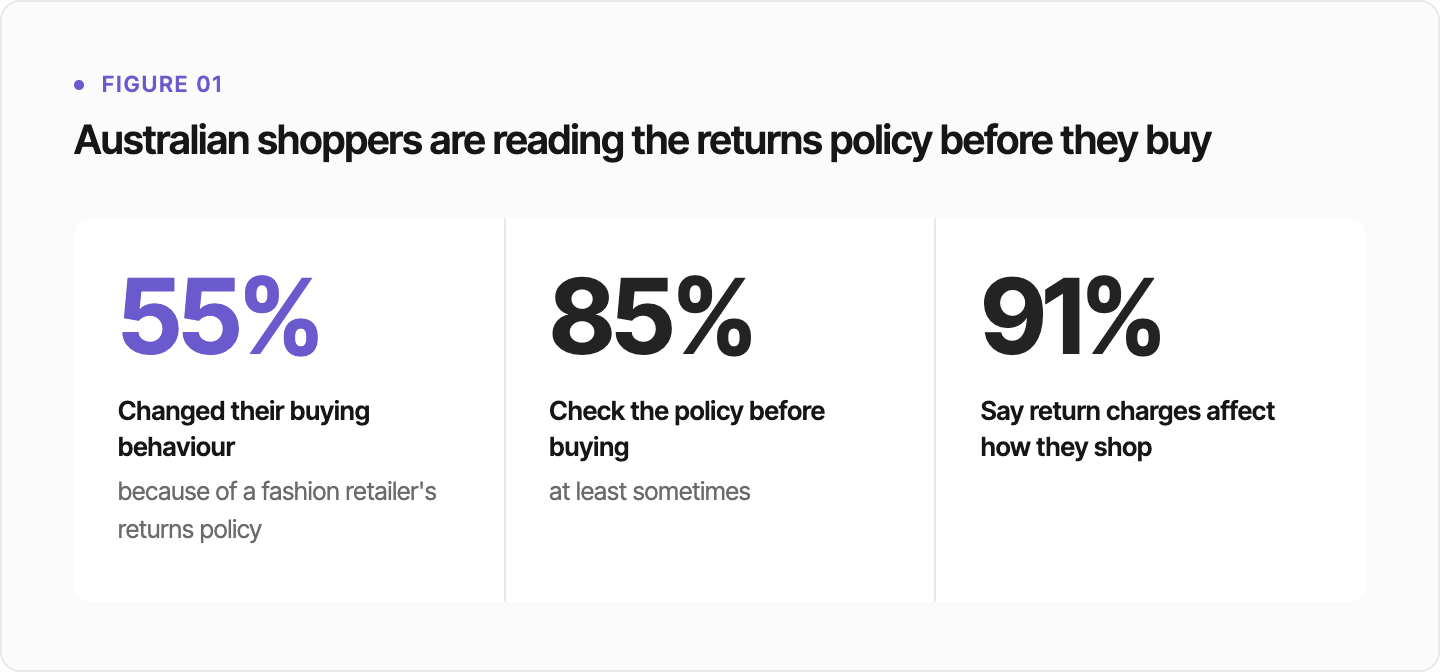
New research suggests the returns policy has quietly become one of the first things an Australian shopper checks and one of the last things a retailer manages well. Loop's report The Returns Revenue Gap, a survey of 1,000 Australian shoppers and 200 retail decision-makers, found that 55% of online shoppers have changed their buying behaviour because of a fashion retailer's returns policy, that 85% check the policy at least sometimes before buying, and that 91% say return charges affect how they shop. The findings were reported by Inside Retail. The numbers are Loop's own survey data, so read them as reported rather than independently confirmed.
Why it matters here
Australian retailers spent the last two years tightening returns — paid return shipping, shorter windows, stricter conditions — to protect margin as freight and processing costs rose. That was a rational response to a real cost. What this research says is that shoppers noticed, and a majority now factor the policy into where they buy in the first place. In a market this concentrated, where a handful of chains compete for the same customers, a policy that quietly sends even a slice of shoppers to a competitor is not a cost saving. It is lost revenue that never shows up in the returns line.
The take
My view is that returns have moved from a back-office cost to a front-of-store decision, and most retailers are still managing them as the former. The instinct to treat returns as a logistics problem to be minimised is exactly backwards for the part of it that matters most. If 55% of shoppers change behaviour over a policy, then the policy is doing marketing, for you or against you, before a basket is ever built. The retailers who get this right will treat the returns policy as part of the storefront, not part of the warehouse.
The measurement mistake is the tell. In the same research, only 10% of retailers named customer churn as the biggest financial cost of returns; most pointed to lost revenue and logistics. Those are the costs that are easy to see on an invoice. Churn — the shopper who quietly stops buying because returning something was painful once — is the expensive one, and almost nobody is counting it. You cannot manage what you do not measure, and a business optimising hard against the visible cost while ignoring the invisible one will make its returns process cheaper and its customer base smaller at the same time.
What to watch and do
The useful work is to measure the customers you lose, not only the parcels you take back. Track repeat purchase rates split by whether a shopper has returned something and how that return went, and you will start to see the churn number the invoice hides. Then treat any tightening of the policy as an experiment with a revenue side, not just a cost side: test it, watch conversion and repeat rates, and be willing to find that a more generous policy pays for itself. The point is not that returns should be free. It is that the policy is now a commercial decision made in full view of the customer, and it deserves the same rigour as a pricing change.

Subscribe for cutting-edge AI updates
Get the latest thinking on AI-powered retail — from product personalisation to in-store innovation — delivered to your inbox once a month.