
What a Unified Checkout Solution Really Means for Multi-Location Enterprise Retailers
Article highlights
- The standard definition of "unified checkout" doesn't include the store. Most vendor pitches describe a frontend architecture (headless commerce) and a payments architecture (one gateway) — both of which leave the cart object fragmented across POS and ecommerce systems.
- The cart object is the architectural unit that matters, not the channel. A genuinely unified checkout treats the cart as an independent entity any channel can read from and write to — which forces customer identity to be resolved before transaction, not after.
- In-store cart abandonment is the same phenomenon as online cart abandonment, measured by different teams. 68% of shoppers abandon physical queues; the reason this damage is so severe is that the abandoned in-store cart has nowhere to go — there's no mobile equivalent waiting for the customer.
- Mobile-in-store usage means most customers are already operating in two channels at once. 56% of US consumers use a retailer's app while shopping in-store, which means the architectural choice isn't whether to unify channels — it's whether to keep pretending the parallel carts aren't already happening.
- Payment method portability is the most under-engineered piece of "unified" experiences. Most retailers can display a cart at the till; almost none can let the customer pay through the till using a payment method authenticated on their phone — which is the practical test of whether the cart is actually unified.
Walk into a vendor briefing on "unified checkout" and you'll hear the same pitch from three different angles. The platform vendor will tell you it means headless commerce — one frontend layer, multiple backends. The payments provider will tell you it means a single payment gateway processing transactions from every channel. The POS company will tell you it means their hardware now also accepts online orders.
None of these definitions describe a unified checkout. They describe unified infrastructure underneath the checkout, which is a different problem entirely. And for multi-location enterprise retailers, conflating the two has become one of the most expensive strategic mistakes of the last decade.
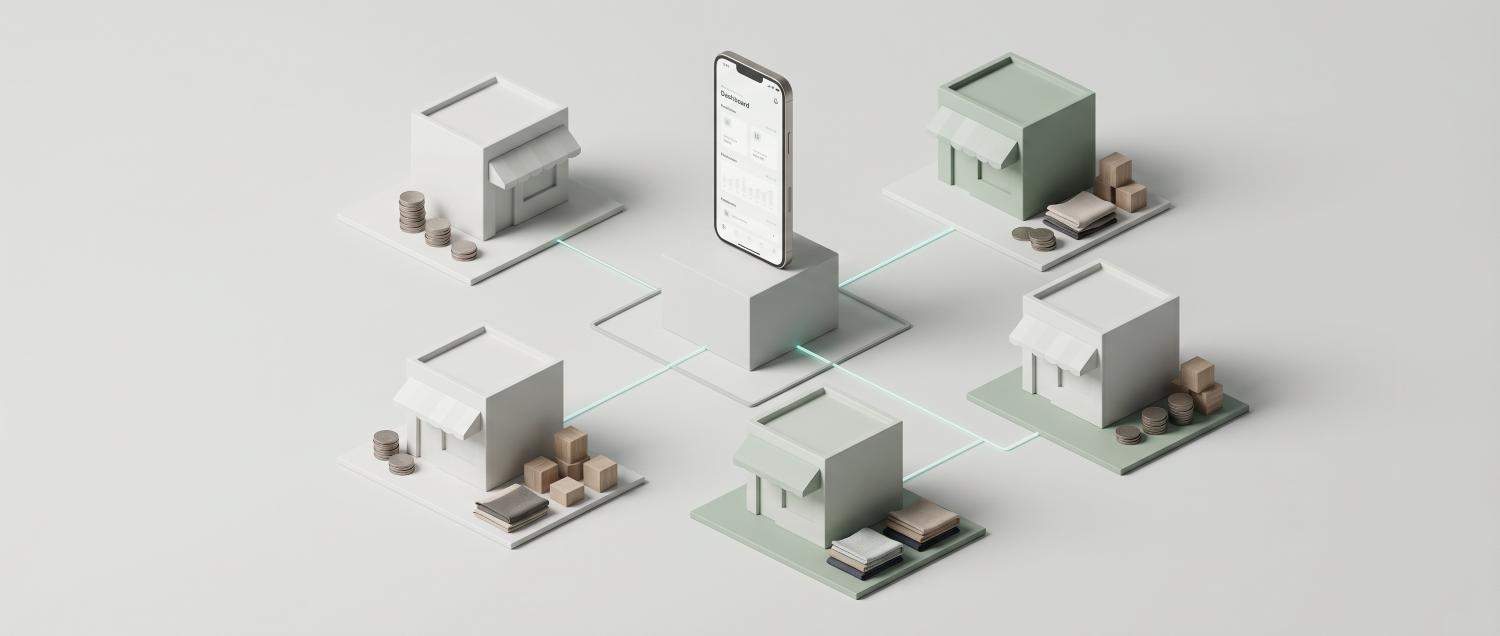
A genuinely unified checkout solution is defined by a single attribute: one cart state shared across every channel a customer can touch. The same cart on the store iPad as on the mobile app as on the desktop site as on the kerbside pickup screen. The same cart whether the customer started in-store, switched to mobile, abandoned for three days, and came back via web. Not a synced cart. Not a replicated cart. The same cart.
That's a fundamentally harder problem than running one payment gateway, and most enterprise retailers have not yet grappled with what it actually requires.
Why the standard definition falls apart in the store
The headless-commerce-plus-payment-gateway definition works fine if your only channels are web and mobile. Both are digital. Both share an authenticated session. Both can hit the same backend cart object and call it a day.
The moment you add a physical store, that architecture breaks. A customer browsing on their phone in the car park has no authenticated relationship with the queue inside. The associate scanning items on a mobile POS isn't writing to the same cart database as the ecommerce platform — they're writing to the POS system, which syncs to inventory but not to the customer's session. When that customer pulls out their phone at the till to apply a digital voucher loaded into their app, the cart they're holding and the cart on the associate's screen are two separate records.
This is the architectural reality behind the friction most retailers describe as "channel handoff." It isn't a UX issue. It isn't a training issue. It's a data model issue — and no amount of headless front-end work will fix it, because the cart objects living in your POS and your ecommerce platform were never designed to be the same object.
The infrastructure problem hiding inside the checkout problem
The reason this matters now, in 2026, is that the underlying systems weren't built to handle it. Over 70% of retailers still run POS software more than two years old, and 40% rely on systems over five years old. Those systems were architected when "checkout" meant a fixed terminal in a store and "ecommerce" meant a separate website with its own database. They were never asked to share state with anything.
Layered on top of that, only 13% of retailers believe their current technology will meet future customer expectations, and 89% fail to scale innovations organisationally. The gap between what enterprise retailers know they need and what their stack can deliver has become structural rather than tactical.
A unified checkout solution sits at the centre of that gap. It is the layer that has to reconcile decades of separately-built systems into one coherent transaction experience — and it has to do so without a rip-and-replace programme that no CFO will fund. In an environment where 77% of retailers report frequent budget cuts and 83% prioritise efficiency over customer experience innovation, the practical question is not "can we build the perfect unified stack" but "what is the smallest architectural change that produces a single cart state."
What "one cart state" actually requires
Strip away the marketing language and a unified checkout solution requires four capabilities working together. None of them is optional, and missing any one of them produces the half-unified experiences most enterprise retailers currently offer.
First, a cart object that lives independently of the channel that created it. The cart cannot be a property of the POS, the ecommerce platform, or the mobile app. It has to be its own entity, with its own identifier, that any channel can read from and write to. This is the foundational shift — and it's the one most "unified commerce" platforms quietly avoid, because it requires customers to be identifiable across channels before they transact, not after. In practice, that means the loyalty programme stops being a separate database queried by each channel and starts being the identity layer the cart is anchored to. The cart belongs to the customer, not the till.
Second, real-time inventory visibility tied to the cart, not the channel. When a customer adds an item to a cart on their phone, the same stock-on-hand check has to fire whether they complete the purchase online, ask the associate to ring it up in-store, or convert to click-and-collect. The cart needs to hold a reservation that all channels honour, not three separate reservations across three separate systems. Most enterprise retailers run inventory in batch — refreshed every fifteen minutes, every hour, sometimes nightly — which means by the time the cart is committed, the inventory state behind it is already stale. Unified checkout pushes inventory from a batch system to an event-driven one, and that shift alone is a multi-quarter programme for most operators.
Third, payment method portability. The customer should be able to start a cart logged in via the mobile app — with their saved card, BNPL arrangement, POLi or PayID account, or store credit attached — and complete the purchase at a physical till without re-entering anything. This is the single most under-engineered piece of "unified" experiences today. Most retailers can show the customer their cart at the till; almost none can let the customer pay through the till using a payment method authenticated on their phone. The result is a customer who logged in, built a cart, walked to the queue, and then re-entered everything they'd already entered — because the payment layer treats the till as a separate environment from the app, even when both are owned by the same retailer.
Fourth, fulfilment optionality at the moment of payment. A unified cart should let the customer choose, at checkout, whether the items go home with them, get shipped, get picked up at another store, or get delivered same-day. That decision should be made once, against one cart, with one payment — not split into separate transactions or "buy online, pick up in-store" workflows that are really just two purchases stitched together with a confirmation email. The operational benefit of getting this right is significant: a single cart that allows mixed fulfilment opens up basket-level optimisation that channel-specific carts simply cannot do. If the customer wants three items and one is out of stock in-store, the unified cart lets them ship the missing item without leaving the till — preserving a sale that, under fragmented architecture, would be split across two transactions or lost altogether.
Why this is fundamentally harder than headless commerce
Headless commerce decouples the presentation layer from the commerce engine. That's useful, but it's a frontend architecture decision. The cart object underneath a headless setup is still a single cart object — it just gets rendered by different frontends.
A unified checkout solution decouples the cart object itself from the channel of origin. That's a backend architecture decision, and it ripples through every downstream system: inventory, payments, loyalty, customer data, fulfilment, returns. Every one of those systems has to be queryable and writable by a cart that doesn't belong to any single channel.
This is why the vendors who sell "unified commerce" as headless-plus-one-gateway end up delivering experiences that feel unified on the website and the mobile app but break the moment a physical store is involved. The store was never modelled as a peer channel in their architecture — it was modelled as a separate system that gets reconciled overnight.
The checkout abandonment data nobody connects to this
The conversation about cart abandonment has been stuck on the ecommerce side for fifteen years. Free shipping, fewer form fields, guest checkout, exit-intent popups. All of which matter — but all of which presume the cart abandonment is happening on the channel that owns the cart.
Inside the store, abandonment looks completely different. 82% of shoppers will avoid a store altogether if they see a queue. 68% abandon physical queues before reaching the till. 40% will leave and go to a competitor to complete the purchase. Seventy per cent of retailers say a shopper will abandon within five minutes of waiting.
These are not separate phenomena from online cart abandonment. They are the same phenomenon — friction at the moment of conversion — measured in different channels by different teams who don't compare notes. And the reason the in-store version is so brutal is that the customer who walks out doesn't have a cart waiting for them on their phone. They have to start over. If the cart had been unified, the abandoned in-store cart would surface in the mobile app within minutes, with a "complete on your phone" option that recovers the sale before the customer reaches the car park.
This is the operational case for unified checkout that headless-commerce framing completely misses. Unified checkout isn't about elegance. It's about cart recovery across the boundary that currently destroys the most value — the boundary between channels.
The mobile layer makes it worse, not better
The default assumption in most enterprise retail strategies is that mobile is the bridge between online and in-store. Customers research on the app, the thinking goes, then buy in-store, then re-engage on the app afterwards.
The data tells a more complicated story. 69.2% of web visits to top retailers now originate from mobile devices, and 56% of US consumers use a retailer's mobile app while shopping in-store. That means the customer in your store, holding your app, is already in two channels simultaneously — and your checkout architecture almost certainly treats them as one customer with two separate carts.
When that customer scans an item with the app for product information, then walks to the till to buy it, those interactions never connect. The cart the app started building? Discarded. The customer profile? Re-authenticated from scratch at the POS, if at all. The personalised recommendation the app surfaced? Invisible to the associate. Each channel ran its own race, and the customer experienced the friction of switching between them.
Unified checkout collapses those parallel carts into one. The item the customer scanned on the app is in the cart by the time the associate picks them up. The recommendation is visible to the associate. The customer doesn't choose between paying on the app or paying at the till — they choose where, and the cart handles the rest.
The operator-level consequence of getting this wrong is rarely measured because the data lives in different systems. When the customer's app cart is discarded as they walk to the till, the ecommerce analytics record it as a cart abandonment. The POS records the same purchase, completed at the till, as a fresh in-store transaction with no prior context. From the reporting perspective, those two events look unrelated — and the retailer optimises each one in isolation, never realising they're two halves of the same conversion. Unified checkout fixes the data problem as a side effect of fixing the cart problem.
What enterprise retailers should ask vendors
The vendor landscape is full of products that describe themselves as "unified" but solve only fragments of the problem. A practical filter for separating real unified checkout solutions from rebranded headless commerce is to ask these questions in a vendor evaluation:
Can a customer start a cart in-store and complete it on mobile three days later without any data being passed manually? If the answer involves "we sync nightly" or "the associate emails them a link," the cart is not unified — it's being duplicated.
When inventory is reserved by an in-progress cart, can that reservation be honoured by any channel? If reservations only apply to the channel that created them, you have channel-specific carts wearing a unified UI.
Can payment methods authenticated in one channel be used in another without re-entry? If the customer has to tap their card or enter a CVV again at the till despite being logged in on their phone, the cart and the payment method are not actually connected.
Does the cart survive across sessions, channels, and devices as a single record? Or does each channel maintain its own version that gets reconciled later? The difference between "single record" and "reconciled records" is the entire definition of unified.
The strategic frame: one transaction, not one technology
The reason most enterprise unified commerce programmes underdeliver is that they're scoped as technology consolidation projects — replace three systems with one, simplify the stack, save on licensing. That framing puts the savings up front and pushes the customer experience benefits into a vague future state. It also tends to produce architectures that look unified on the org chart but still treat the store as a separate world from the website.
A unified checkout solution should be scoped the other way around. Start from the transaction the customer is trying to complete and work backwards through the architecture required to support it. The customer doesn't experience your POS, your ecommerce platform, or your headless commerce layer — they experience the checkout. If the checkout is one transaction in their mind and three transactions in your data, the gap will leak revenue every day until it's closed.
There's also a measurement implication that most operators miss. When the cart is unified, the metrics finally line up: conversion rate becomes a cross-channel figure rather than a channel-specific one, abandonment becomes recoverable rather than terminal, and customer lifetime value can be calculated against actual behaviour rather than the partial behaviour each channel sees. Unified data is a downstream benefit of a unified cart, not a prerequisite for it — which is why retailers who chase "unified customer data" before unifying the cart end up with cleaner reports about the same fragmented experience.
The retailers who get this right in the next two to three years will not be the ones with the most sophisticated headless setups or the most aggressive payment consolidation programmes. They will be the ones who treated the cart as the primary architectural object and built everything else — channels, payments, inventory, fulfilment — to serve a single cart state. That's a smaller change than a full replatform and a larger change than a UX refresh, which is part of why it's been so consistently under-prioritised.
Everything else is unified branding wrapped around fragmented infrastructure. The customer will feel the difference long before the org chart catches up.

Subscribe for cutting-edge AI updates
Get the latest thinking on AI-powered retail — from product personalisation to in-store innovation — delivered to your inbox once a month.